Sceptical Paths by Giuseppe Veltri Racheli Haliva Stephan Schmid Emidio Spinelli
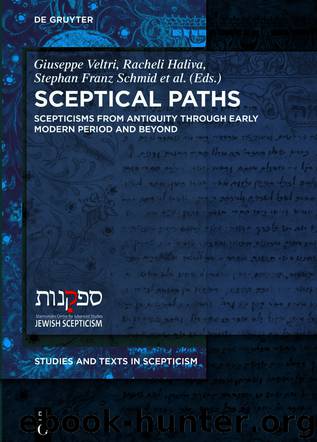
Author:Giuseppe Veltri, Racheli Haliva, Stephan Schmid, Emidio Spinelli
Language: eng
Format: epub
Publisher: De Gruyter
Published: 2019-09-02T13:58:38.525000+00:00
The most apt phrase concerning this subject is the dictum occurring in the Psalms, Silence is praise to Thee (Psalms 65:2), which interpreted signifies: silence with regard to You is praise […] Accordingly, silence and limiting oneself to the apprehensions of the intellects are more appropriate—just as the perfect ones have enjoined when they said: Commune with you own heart upon your bed, and be still. Selah (Psalms 4:5) (1:59, 139‒40).
The silence in this passage is not only silence in external but also in inner speech: neither affirmative nor negative privative attributions express truths, hence, praise of God.43 The silence is also an expression of epochē. By holding back from representing God using a false expression, thereby acknowledging the limitations of one’s representational powers, one expresses God’s greatness. At the same time, the silence is conjoined with “limiting oneself” to the domain in which there are “apprehensions of the intellect” in which knowledge is possible. Silence with respect to metaphysics goes along with continuing skepsis in the sublunar domain of natural science.
To return finally to Maimonides’s diagnosis of his scepticism with respect to knowledge of metaphysics, his ultimate explanation of the human epistemic condition is that he is a hylomorphic substance whose matter limits the extent which his form or intellect can be actualised.44 As he writes in explanation of why he cannot have knowledge of the existence of the deity: “[God] has enabled man to have knowledge of what is beneath the heavens, for that is his world and his dwelling place” (2:24, 327)—i. e., as a composite material substance, the human’s natural place is the world of the elements, and it is there that he can achieve knowledge. But among his material, or bodily, faculties, a particular source of the sceptical limitations on the human intellect is his imagination.45 As we saw with the syntactic problem of divine attributes, our human intellects must apprehend God through inner speech representations that necessarily employ composite subject-predicate syntax. Why “necessarily”? Because, as embodied intellects, we can never free our representation of an existent from the influence of the body, forced by our “wish to preserve the conception of the imagination” (1:51, 114).
For Maimonides, this representational role of the imagination is a general obstacle to knowledge of immaterial beings. Not only is the one God conceived in corporeal terms as an essence or substratum with attributes (1:51, 114). Similar antinomies arise, as we saw, with the idea of emanation (fayḍ) which Maimonides regards as the best available figure to express the causality of an immaterial being even though it is inadequate to the task of expressing the “true reality”: “For the mental representation of the action of one who is separate from matter is very difficult, in a way similar to the difficulty of the mental representation of the existence of one who is separate from matter” (2:12, 279). Again, the difficulty is that the imagination, a bodily faculty, cannot represent any existent except as a body or any action except as a spatio-temporal event.
Download
This site does not store any files on its server. We only index and link to content provided by other sites. Please contact the content providers to delete copyright contents if any and email us, we'll remove relevant links or contents immediately.
| Africa | Americas |
| Arctic & Antarctica | Asia |
| Australia & Oceania | Europe |
| Middle East | Russia |
| United States | World |
| Ancient Civilizations | Military |
| Historical Study & Educational Resources |
Cecilia; Or, Memoirs of an Heiress — Volume 1 by Fanny Burney(32640)
Cecilia; Or, Memoirs of an Heiress — Volume 2 by Fanny Burney(32014)
Cecilia; Or, Memoirs of an Heiress — Volume 3 by Fanny Burney(31999)
The Secret History by Donna Tartt(19321)
Sapiens: A Brief History of Humankind by Yuval Noah Harari(14470)
Leonardo da Vinci by Walter Isaacson(13414)
The Radium Girls by Kate Moore(12098)
Sapiens by Yuval Noah Harari(5412)
How Democracies Die by Steven Levitsky & Daniel Ziblatt(5280)
The Wind in My Hair by Masih Alinejad(5142)
Homo Deus: A Brief History of Tomorrow by Yuval Noah Harari(4965)
Endurance: Shackleton's Incredible Voyage by Alfred Lansing(4849)
Man's Search for Meaning by Viktor Frankl(4676)
The Silk Roads by Peter Frankopan(4603)
Millionaire: The Philanderer, Gambler, and Duelist Who Invented Modern Finance by Janet Gleeson(4541)
The Rape of Nanking by Iris Chang(4269)
Joan of Arc by Mary Gordon(4160)
The Motorcycle Diaries by Ernesto Che Guevara(4155)
Stalin by Stephen Kotkin(4013)
